
Welcome to the Winson Pneumatic & Hydraulic Struts official website!
 Tel:+86 13780014913
  E-mail:[email protected]



Five Deadly Mistakes When Choosing Lockable Gas Springs
Author:Winson Gas Spring & Hydraulic Damper
Click:
Time:2026-02-25 09:26:50
Lockable gas springs—the 'magic wands' that let equipment hover at any position—are increasingly used in furniture, medical devices, and industrial equipment. But it's precisely this 'locking' function that makes selection far more complex than for ordinary gas springs.
Many buyers only look at length and price, only to discover after installation: won't lock, won't move, won't last. Today, we comb through the five most common pitfalls when selecting lockable gas springs—to help you get it right the first time.
Contact Me
Mistake 1: Only Looking at Total Length, Ignoring Stroke
This is the most common error.
People grab a tape measure, check the installation distance, and say, 'I need a 500mm one.' But they overlook the key parameter—stroke (how far the piston rod can extend).
Why It's a Pitfall:
- Gas springs with the same total length can have vastly different strokes
- Too short a stroke means the equipment won't fully open
- Too long a stroke may exceed installation space, potentially damaging the gas spring
Correct Approach:
Measure two numbers—mounting center distance (distance between mounting points) and required movement range. When installing, leave about 10mm clearance between the rod end fitting and the guide when fully compressed to prevent damage.
Mistake 2: Only Asking 'How Much Can It Lift?' Not 'How Does It Lock?'
'I need one that can support 20kg.'—That's correct, but only half the story.
The key to lockable gas springs lies in how locking/unlocking operates:
- Push-to-Lock: Locks automatically when pushed to desired position; push again to unlock
- Cable-Release: Requires pulling a mechanism (handle, cable) to unlock
- Rotary: Locks/unlocks by rotating the piston rod
Why It's a Pitfall:
Choose the wrong operation type, and daily use becomes awkward. Imagine a narrow cabinet—if you select a cable-release model, you can't even reach the cable. How would you use it?
Correct Approach:
Think it through: Does the user operate with one hand or two? Is operating space restricted? How frequent is use? Choose the most intuitive locking method for your actual scenario.
Mistake 3: Ignoring the Importance of Locking Force
Many people only care about support force (the force lifting the load) and overlook locking force (how much external force the lock can withstand).
Why It's a Pitfall:
Support force is sufficient, but locking force isn't—result: you adjust your chair angle, lean back, and 'click'—it slides back; you lock a worktable, place a heavy object on it, and it slowly sinks.
Correct Approach:
Understand the dynamic loads in your application. Medical beds, for example, must not only support patient weight but also withstand shifting forces when patients move. Choose a model with locking force exceeding actual working loads, leaving a safety margin.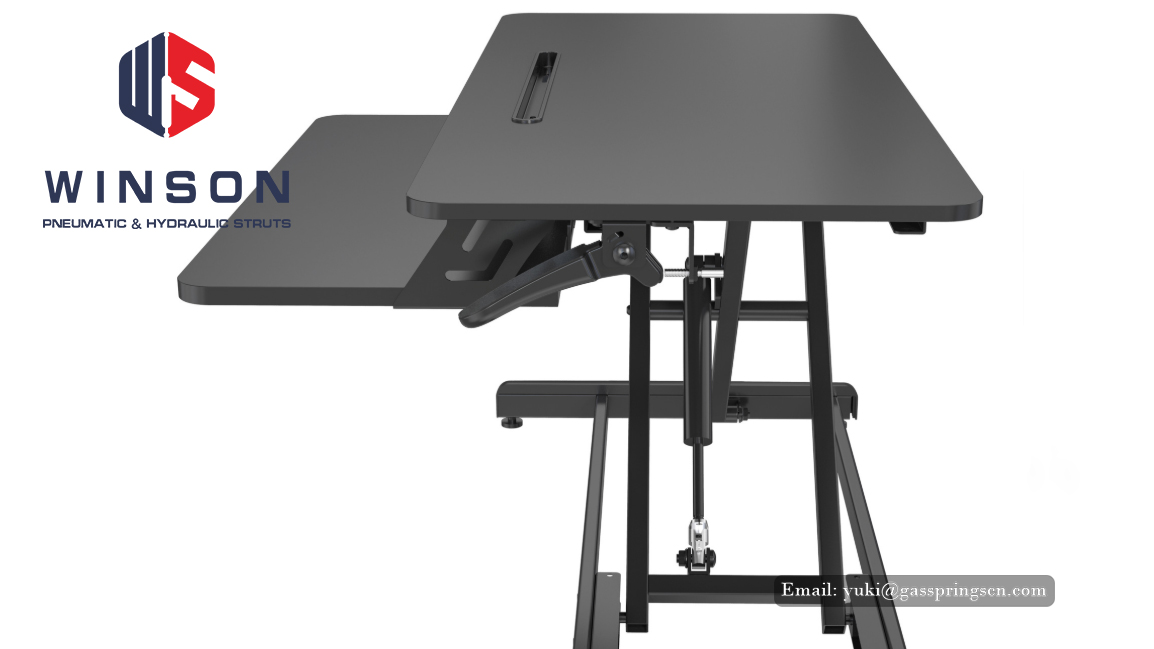
Mistake 4: Not Considering Usage Frequency
'This gas spring is cheap, let's try it.'—A common thought.
But lockable gas spring lifespan is directly tied to usage frequency. Locking 10 times daily versus 100 times daily creates completely different wear on internal valves and seals.
Why It's a Pitfall:
Choose a model suited for occasional use but install it on an office chair adjusted frequently—within three months, it leaks, won't lock. You saved a little money, but now you're spending more on replacements, and your product's reputation suffers.
Correct Approach:
Estimate daily usage times. High-frequency applications (office chairs, standing desks) should choose models validated through lifecycle testing—ask suppliers for test data: 20,000 cycles? 50,000? 100,000?
Mistake 5: Ignoring Environmental Factors
Lockable gas springs contain precise valves and seals—they're sensitive to environment.
Which Environmental Factors Are Pitfalls:
- Temperature: Standard seals harden below -30°C and may accelerate aging above 80°C. According to the ideal gas law, temperature changes directly affect support force.
- Humidity/Corrosion: Standard carbon steel housings rust easily in humid environments; rust particles can enter seals, causing leaks
- Dust/Debris: If the piston rod gets sandy, each movement scratches sealing surfaces, leading quickly to leaks
Correct Approach:
Clarify your usage environment upfront. For outdoor or humid environments, choose stainless steel or special surface treatments; for dusty environments, consider dust covers; for extreme temperatures, inform suppliers to select special sealing materials.
Summary: Four Steps to Choosing the Right Lockable Gas Spring
- Measure Accurately: Total length + stroke—both essential
- Calculate Loads Correctly: Support force + locking force—both must cover actual usage
- Think Through Operation: Locking method should be intuitive; operating space adequate
- Clarify Environment: Temperature, humidity, dust—tell your supplier upfront
Lockable gas springs aren't standard parts—they're 'technology partners' that need matching. Choose right, they're your equipment's capable assistant; choose wrong, they're a daily source of frustration.
What application are you selecting lockable gas springs for? Share in the comments—let's discuss.
#LockableGasSpring #IndustrialSelection #GasSpring #MechanicalDesign #ProcurementGuide
Top

Winson is a Chinese Gas Spring & Hydraulic Damper manufacturer specializing in custom compression, lockable, tension types and stainless steel gas springs & oil dampers for a variety of applications of automotive and vehicle, furniture, machineries, medical & fitness equipments.
Contact Us
Tel/WhatsApp:+86 0137-80014913
Email: [email protected]
Address:(14-16),No.26,Building 4,Oriental Business Center, Yinzhou, Ningbo, Zhejiang, China 315100
Copy Right @ Winson Pneumatic & Hydraulic Struts All Rights Reserved
Custom Gas Spring & Hydraulic Damper For Global Clients | Phone / WhatsApp:+86 13780014913 | Copy Right @ Winson Pneumatic & Hydraulic Struts, All Rights Reserved.
 QQ
QQ WhatsAPP
 E-mail