Welcome to the Winson Pneumatic & Hydraulic Struts official website!
 Tel:+86 13780014913
  E-mail:[email protected]



How Gas Springs Turn "Support" into Art
Author:Winson Gas Spring & Hydraulic Damper
Click:
Time:2026-02-24 14:11:48
When Weight Meets Wisdom
Imagine a simple action: lifting a car hood.
Without a gas spring, you'd need all your strength to hold up a dozen kilograms of metal, then find a support rod to lock it in place—either fully open or fully closed, no in-between.
With a gas spring? A gentle lift and it rises automatically; a soft push and it lowers slowly. Throughout the process, the heavy object seems to have lost its weight.
This isn't magic. It's the delicate balance of gravity achieved by gas springs.
The Core Philosophy: Not Confrontation, But Balance
Traditional mechanical support operates on 'confrontation'—lock with latches, secure with pins, resist with friction. This approach offers only two states: open or closed, supported or released.
Gas springs are fundamentally different.
High-pressure nitrogen sealed inside the cylinder stores energy when compressed and releases thrust when extended. This force is precisely calculated to exactly counterbalance the object's weight. The object appears to float in mid-air—neither falling nor rising, suspended in a wonderful state of 'weightlessness.'
This isn't conquering gravity. It's dancing with it.
Contact Me
The Secret of Constant Force: Why 'Just Right' Is So Difficult
How precise must the force be to make an object float?
The answer: Extremely precise.
If the error exceeds 5%, the object will begin to move slowly; if it exceeds 10%, noticeable dropping or bouncing will occur. And gas springs must maintain this precision across temperatures from -30°C to 80°C, after tens of thousands of cycles.
The technical challenges behind this:
Pressure and Area Balance: Force = Pressure × Piston Area. Top-tier gas springs control annual leakage below 1%, with piston rod diameter tolerances at the micron level—any si deviation translates into force fluctuations.
Invisible Friction: Friction between seals and metal surfaces disrupts force purity. Triple-layer composite seals plus specialized lubricants make movement as smooth as silk.
Temperature Compensation: According to the ideal gas law, temperature changes directly affect pressure. High-end gas springs use special gas formulations and compensation structures to control temperature impact within 5%.
Four Dimensions That Define 'Good Support'
An exceptional gas spring reshapes experience across four dimensions:
1. Force Precision
Does support force precisely match the load? Is it consistent at different positions? Premium products control force error within ±3%, allowing objects to 'float' at any position.
2. Motion Smoothness
Force is constant, but is motion smooth? Jerks at startup? Impact at stopping? Progressive damping technology lets gas springs automatically decelerate at stroke ends, eliminating collision and vibration.
3. Temporal Stability
Works well today, but what about a year from now? After 20,000, 50,000, even 100,000 cycles, performance attenuation must stay within acceptable limits.
4. The Absence of Perception
The highest form of support makes you forget support exists. Your attention is on the task itself, not on fighting mechanical resistance.
Philosophy in Scenarios
Car Tailgates: 15-25kg of metal, two gas springs let it hover at any angle. Hide strength in invisibility, return control to the user.
Hospital Beds: Every position adjustment for critically ill patients can bring pain. Ultra-smooth motion and impact-free stopping make bedboard movement gentle as flowing water—supporting not just weight, but dignity.
Industrial Workstations: Components over 50kg, without assistance support, exclude or older workers. Gas springs make heavy objects light, removing physical strength as a barrier.
Standing Desks: 8-10 sit-stand transitions daily. If every lifting comes with jerks, noise, or speed inconsistency, even the best health concept will be abandoned. Gas springs make lifting a pleasure, not a burden.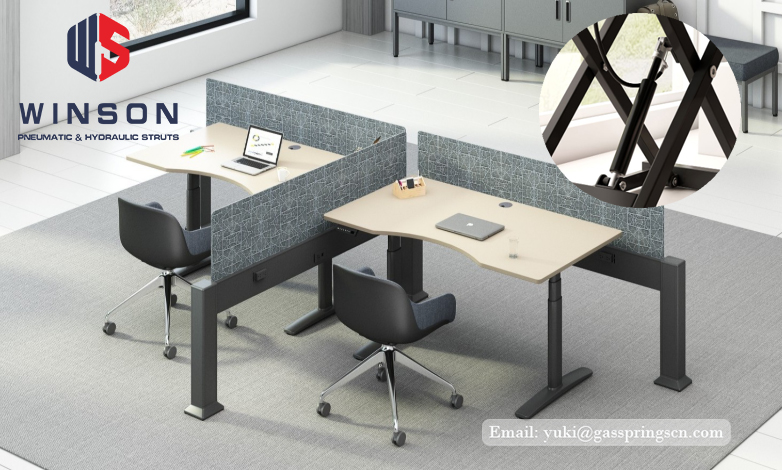
How to Choose: Five Key Questions
When selecting gas springs for your product, ask yourself:
1. What is your load? Not just static weight, but usage frequency, operation method, safety factors. Force needs precise matching, not 'close enough.'
2. What is your environment? Temperature range? Humidity? Corrosive substances? Cleaning requirements? Different environments need different materials and surface treatments.
3. What motion characteristics do you need? Constant speed throughout? Deceleration at ends? Free stopping? Different damping designs create completely different feeling.
4. What is your lifespan expectation? A storage box opened occasionally, or heavy equipment opened dozens of times daily? Lifespan requirements directly impact seal design and testing standards.
5. What are your safety standards? Anti-burst structure? Overload protection? Emergency release? Safety is always the top priority.
Conclusion: Forgetting Gravity Exists
We live in a world ruled by gravity. Every movement of every object, every change in height, is a negotiation with this eternal law.
The wisdom of gas springs lies in choosing cooperation over confrontation. They don't try to eliminate gravity—they understand it, balance it, utilize it. Ultimately, they transform gravity from a limitation into a partner.
Next time you effortlessly lift a heavy door or smoothly adjust a seat, spare a thought for that unremarkable metal tube. It's conducting its own precis dialogue with gravity.
And the destination of this dialogue is allowing you to forget gravity exists, focusing on what truly matters.
This is the art of support.
#GasSpring #GravityManagement #IndustrialDesign #PrecisionEngineering #Ergonomics
Top

Winson is a Chinese Gas Spring & Hydraulic Damper manufacturer specializing in custom compression, lockable, tension types and stainless steel gas springs & oil dampers for a variety of applications of automotive and vehicle, furniture, machineries, medical & fitness equipments.
Contact Us
Tel/WhatsApp:+86 0137-80014913
Email: [email protected]
Address:(14-16),No.26,Building 4,Oriental Business Center, Yinzhou, Ningbo, Zhejiang, China 315100
Copy Right @ Winson Pneumatic & Hydraulic Struts All Rights Reserved
Custom Gas Spring & Hydraulic Damper For Global Clients | Phone / WhatsApp:+86 13780014913 | Copy Right @ Winson Pneumatic & Hydraulic Struts, All Rights Reserved.
 QQ
QQ WhatsAPP
 E-mail