
Welcome to the Winson Pneumatic & Hydraulic Struts official website!
 Tel:+86 13780014913
  E-mail:[email protected]



Temperature Effects on Gas Springs: Understanding Force Variations from -30°C to 80°C
Author:Winson Gas Spring & Hydraulic Damper
Click:
Time:2026-03-06 09:49:20
In gas spring applications, one critical factor is often overlooked—Temperature. Whether installed on outdoor cabinets in northern regions or safety doors near baking equipment, temperature changes are quietly altering the 'personality' of your gas spring.
This article delves into the mechanism of how temperature affects gas spring performance and guides you on selecting the right model for extreme environments.
Contact Me
--1. The Core Principle: The Gas Law
Gas springs are filled with high-pressure nitrogen, operating on the Ideal Gas Law: PV = nRT
- P = Pressure (directly affects output force)
- V = Volume (gas spring chamber volume, essentially fixed)
- n = Number of gas moles (sealed system, constant)
- R = Gas constant
- T = Absolute temperature (Kelvin)
Key conclusion: When volume V is fixed, pressure P is proportional to absolute temperature T. As temperature rises, pressure increases, and gas spring force increases; as temperature drops, pressure decreases, and force decreases. 
--2. How Much Does Force Change from -30°C to 80°C?
In engineering practice, a simple rule applies: For every 10°C change in temperature, the supporting force changes by approximately 3% - 3.5% .
Taking 20°C room temperature as the baseline:
| Temperature | Temperature Change | Force Change |
|---|---|---|
| 20°C | Baseline | 0% |
| -30°C | 50°C drop | Drop 15% - 17.5% |
| 80°C | 60°C rise | Surge 18% - 21% |
Real-World Impact
Case 1: Car Liftgate (The -10°C Embarrassment)
A vehicle designed at 20°C had gas springs perfectly balancing the liftgate weight (2-3kg opening force). In -10°C winter, force dropped by about 9%-10.5%, shifting the balance point significantly upward. Result: The liftgate wouldn't pop open automatically—users had to struggle to lift it.
Case 2: Industrial Oven Door (The 80°C Hazard)
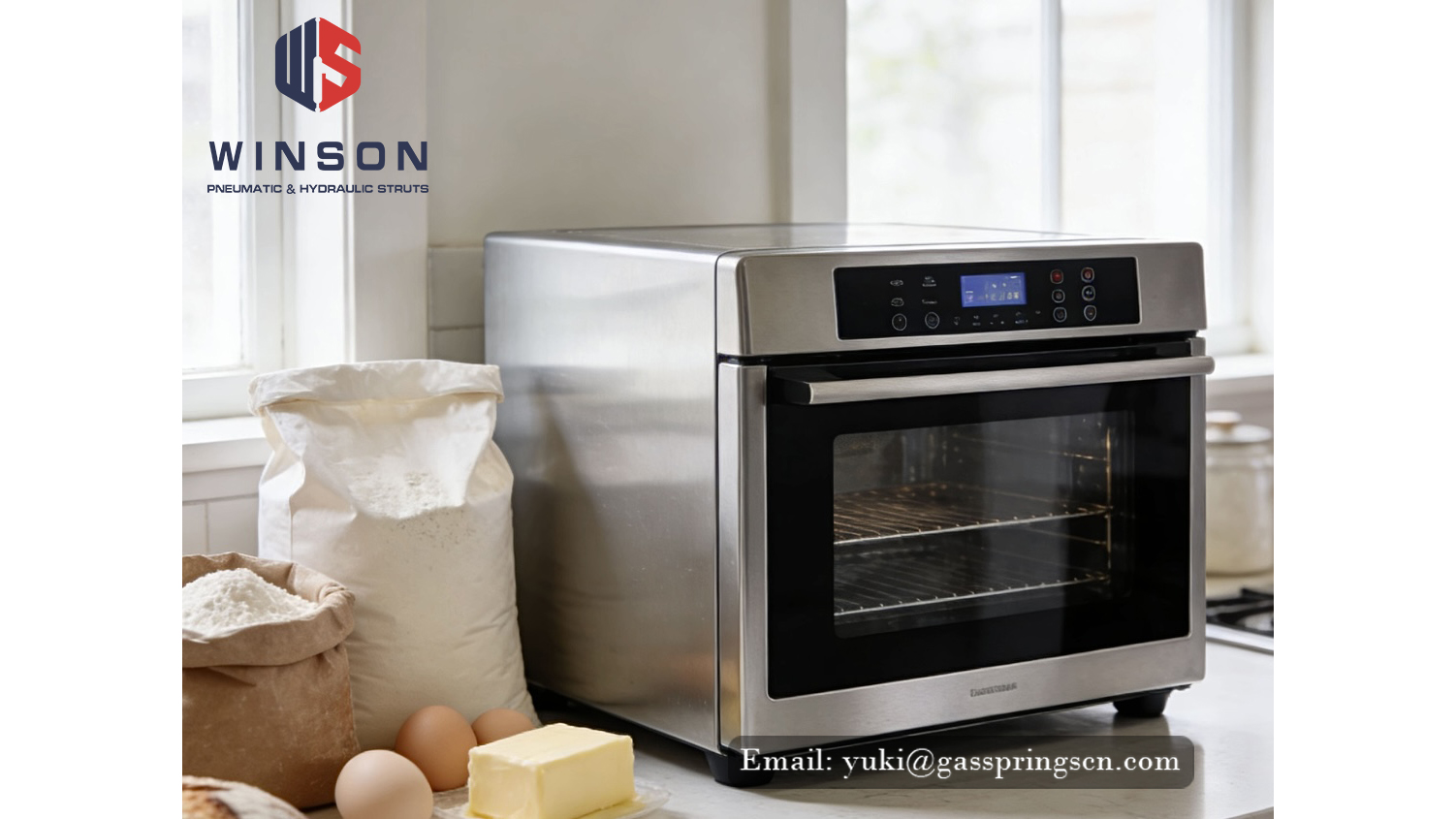
An oven door had moderate closing force at room temperature. When the oven heated to 80°C, the gas spring force surged by about 18%-21%. Result: Closing force became extremely high, making operation difficult; meanwhile, hinges endured over-design loads, shortening their lifespan.
--3. Temperature Challenges for Seals
Low Temperature Challenges (-30°C and below)
- Standard rubber (NBR) becomes hard, brittle, and loses elasticity
- Seal lips cannot conform to the piston rod, creating leakage risk
- Increased movement resistance, rough operation feel
High Temperature Challenges (Above 80°C)
- Standard rubber may suffer permanent deformation, losing sealing capability
- Accelerated seal aging, significantly shortened lifespan
- Lubricating oil/grease may thin and lost, increasing friction
--4. How to Choose High/Low Temperature Resistant Models?
If your equipment must operate reliably in extreme temperatures, standard components may not suffice. Here's your professional selection guide:
1️⃣ Check Seal Materials
| Temperature Range | Recommended Seal Material |
|---|---|
| -20°C ~ 80°C | (NBR) Standard Nitrile Rubber |
| -40°C ~ 120°C | (VMQ) Silicone |
| -20°C ~ 200°C | (FKM/FPM) Fluoroelastomer |
| -50°C ~ 150°C | (EPDM) Outdoor/Weather resistant |
2️⃣ Check Special Structures
High-end lockable gas springs can be equipped with temperature compensation pistons:
- Principle: Using built-in springs or elastic elements to automatically adjust effective chamber volume, offsetting pressure fluctuations caused by temperature changes
- Effect: Maintains relatively stable output force across a wide temperature range, with fluctuation controlled within ±5%
3️⃣ Check Lubrication
- High-temperature models require high-temperature grease (dropping point >200°C)
- Low-temperature models require low-temperature grease (pour point <-50°C) to ensure smooth operation at low temperatures
--5. Selection Recommendations and Considerations
Information to Provide to Suppliers
When ordering gas springs, always specify:
✅ Extreme operating temperatures: Minimum °C? Maximum °C?
✅ Temperature variation frequency: Occasional extremes or continuous exposure?
✅ Force precision requirements: Acceptable fluctuation range (±5%, ±10%)?
Common Misconceptions
❌ 'Room temperature selection is enough; temperature effects are negligible'
✅ Reality: For outdoor equipment, thermal equipment, and cold chain equipment, temperature effects are essential design parameters
❌ 'High temperature resistance just means changing the seal'
✅ Reality: True temperature-resistant design involves a systematic approach including seal materials, lubrication, piston structure, and gas filling pressure
--Summary: Keeping Gas Springs Reliable in Extreme Environments
Temperature effects on gas springs aren't just theoretical 'low-probability events'—they're real engineering challenges. From -30°C winters to 80°C heat, force fluctuations can exceed 20%, enough to make carefully designed mechanisms 'fail.'
Key takeaways:
- Quantify: Every 10°C change = 3%-3.5% force variation
- Seals matter: Extreme temps require upgraded seal materials
- Compensation is premium: Temp-compensated pistons enable stable output across wide ranges
- Communication is fundamental: Always inform suppliers of extreme temperature requirements
Only by incorporating temperature—this 'invisible variable'—into your design considerations can your gas springs 'hold strong and lock tight' in any environment.
Need customized gas spring solutions for extreme environments? Contact us for professional selection support.
#GasSpring #HighTemperature #LowTemperature #LockableGasSpring #TechnologyDiscussion
E-Mail & Wechat Whatsapp: +86 13819751436
Top

Winson is a Chinese Gas Spring & Hydraulic Damper manufacturer specializing in custom compression, lockable, tension types and stainless steel gas springs & oil dampers for a variety of applications of automotive and vehicle, furniture, machineries, medical & fitness equipments.
Contact Us
Tel/WhatsApp:+86 0137-80014913
Email: [email protected]
Address:(14-16),No.26,Building 4,Oriental Business Center, Yinzhou, Ningbo, Zhejiang, China 315100
Copy Right @ Winson Pneumatic & Hydraulic Struts All Rights Reserved
Custom Gas Spring & Hydraulic Damper For Global Clients | Phone / WhatsApp:+86 13780014913 | Copy Right @ Winson Pneumatic & Hydraulic Struts, All Rights Reserved.
 QQ
QQ WhatsAPP
 E-mail