
Welcome to the Winson Pneumatic & Hydraulic Struts official website!
 Tel:+86 13780014913
  E-mail:[email protected]



Installation Angle is Everything: How to Calculate the Mounting Position of a Lockable Gas Spring
Author:Winson Gas Spring & Hydraulic Damper
Click:
Time:2026-03-02 10:17:34
In mechanical design, lockable gas springs are key components for achieving precise opening and locking of hoods, machine tool guards, or medical equipment. However, many engineers overlook a critical detail after selection: the mounting position. Wrong mounting points can not only cause the gas spring to fail in locking at intermediate positions (slipping or jamming) but can also damage the entire mechanism due to insufficient leverage.
This article will explain in simple terms how mounting points affect locking performance and introduce you to the basics of torque calculation, ensuring your gas spring works at its best.
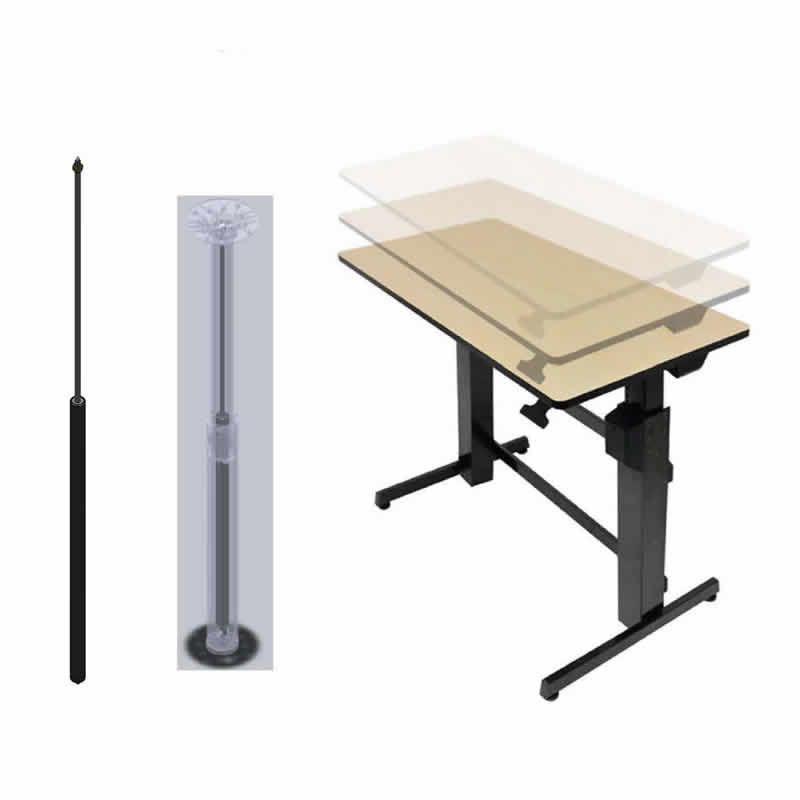
Contact Me
1. How Do Mounting Points Affect Locking?
Gas springs work by generating force through a piston and nitrogen gas inside the cylinder. A lockable gas spring has an internal valve system: when you press the release, the valve opens, allowing gas to flow and the piston rod to move; when released, the valve closes, locking the piston rod in its current position.
The impact of mounting points is mainly reflected in the following aspects:
Lever Arm Length Determines Torque Output
This is the core physical principle. The force generated by a gas spring is linear force along the axis of the piston rod. The torque this force produces on the pivot point (such as the hinge of a lid) equals force magnitude multiplied by lever arm.
The lever arm is the perpendicular distance from the pivot point to the line of action of the gas spring's force. If mounting points are improperly chosen, causing the force line to be too close to the hinge, the lever arm becomes very small. Even if the gas spring itself has a large pushing force, the resulting torque may be insufficient to lift a heavy lid.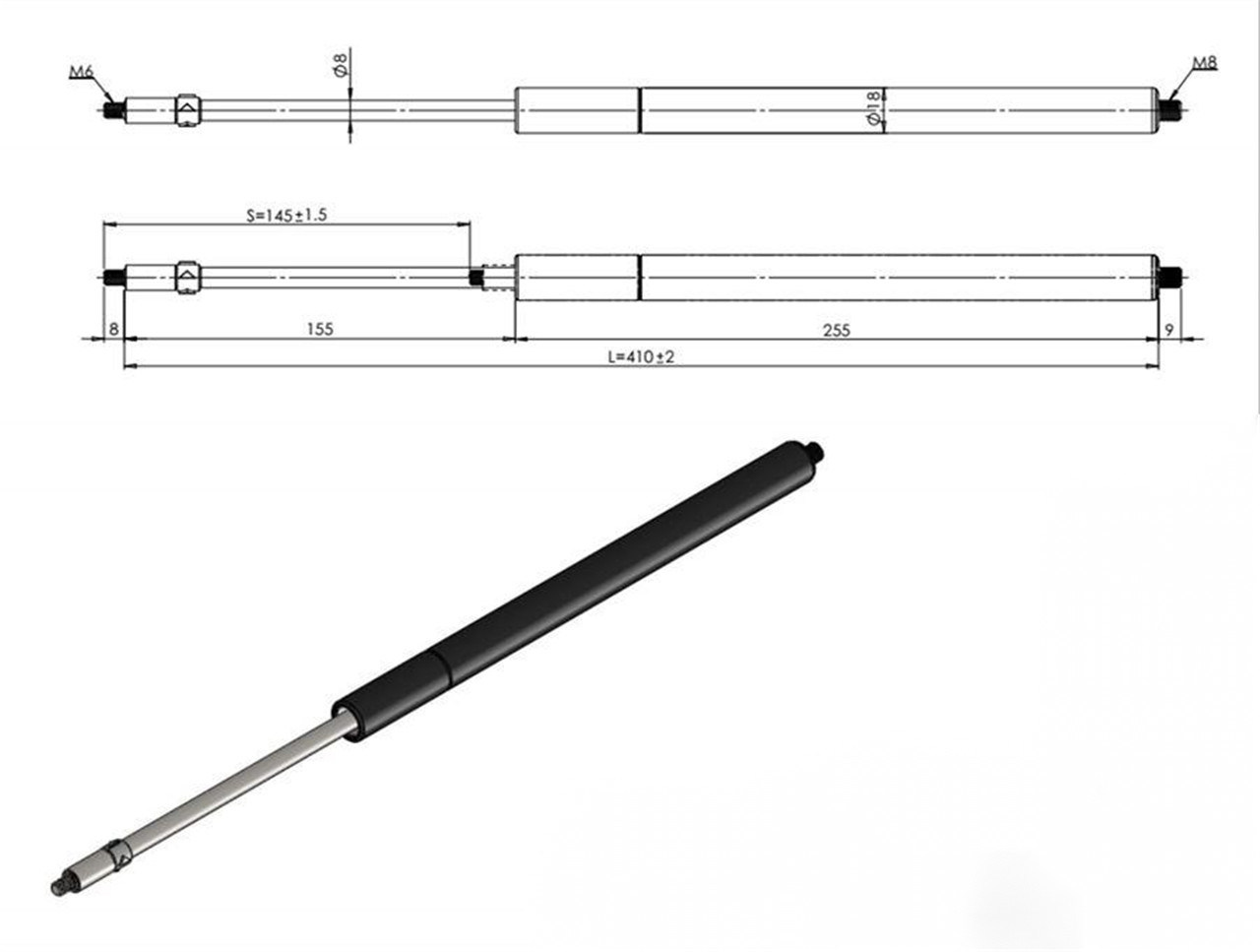
Angle Changes Affect Force Decomposition
During the entire opening process, the angle between the gas spring and the lid continuously changes. This angle determines how much of the gas spring's force is effectively used to lift the lid (tangential component) and how much is wasted pressing against the hinge (radial component).
An ideal mounting position should maintain a relatively favorable angle throughout the entire working stroke, especially at the beginning of opening (where most force is needed) and near the closed position, to obtain sufficient effective torque.
Conditions for Locking Function
For lockable gas springs, the mounting position also determines whether the locking function is reliable. When needing to stop at an intermediate position, the internal locking mechanism must withstand the reverse torque from the load. If the lever arm created by the mounting point is too large, causing the gas spring to bear torque exceeding its rated locking capacity, internal leakage may occur, leading to 'slipping' and inability to lock stably.
2. Torque Calculation Basics: Optimizing Gas Spring Performance
After understanding the importance of mounting points, let's learn how to find the optimal mounting position through simple calculations. This is the core entry-level skill for gas spring applications.
Understanding Basic Physical Quantities
Before starting calculations, we need to clarify several key concepts:
- F (Gas Spring Force): The force output by the gas spring at a specific extension length.
- L (Lever Arm): The perpendicular distance from the hinge center to the gas spring's force line.
- M (Torque): The product of force and lever arm, M = F × L.
- G (Load Weight): The weight of the lid or door being lifted.
- Center of Gravity Position: The point where the load's gravity acts, usually near the geometric center of the lid.
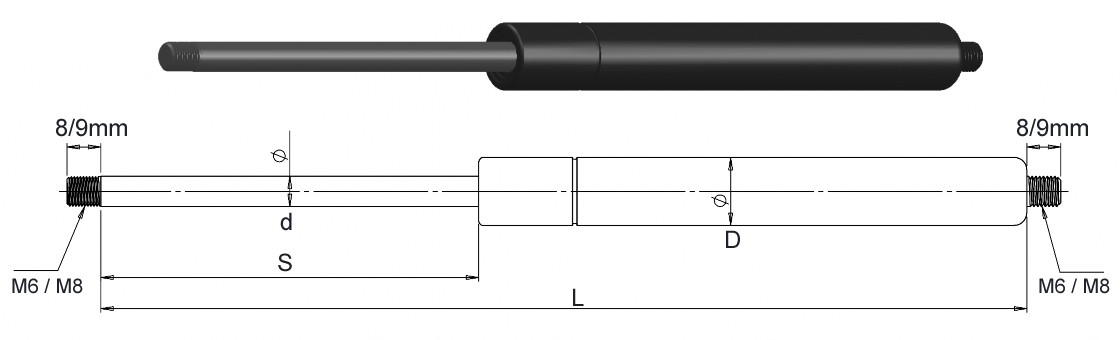
The Classic Two-Point Determination Method
In engineering practice, the most commonly used method is the two-point determination method. Typically, two key positions are selected for calculation and verification:
Position One: Closed State
This is when the gas spring experiences maximum force, as it needs to overcome the maximum resistance torque from the lid's weight (when the center of gravity is farthest from the hinge). In the closed state, we need to:
- Measure the horizontal distance from the hinge center to the lid's center of gravity (gravity lever arm) when the lid is closed.
- Calculate the torque generated by gravity: M_gravity = G × gravity lever arm.
- Preliminarily determine mounting points, draw the gas spring's force line at this position, and measure its lever arm L_close.
- The minimum required gas spring force should be: F_min = M_gravity / L_close.
*Note: Actual selection typically requires multiplying by a safety factor (1.1-1.5) to overcome friction and ensure smooth opening.*
Position Two: Fully Open State
This is the key point for verifying whether the gas spring will 'fling' the lid open at the end position or cause excessive stress on the mechanism. In the fully open state, we need to:
- Measure the gas spring's lever arm L_open at this position.
- Calculate the torque generated by the gas spring: M_spring = F_selected × L_open (F_selected is the actual force of the selected gas spring).
- Calculate the torque generated by gravity at this position (note: as the lid lifts, the center of gravity position changes, and the gravity lever arm shortens).
- The ideal state is M_spring slightly greater than M_gravity, keeping the lid open without falling on its own.
Triangle Geometry Method for Point Selection
The two mounting points of a gas spring (the tail end fixed to the cabinet and the front end fixed to the lid) together with the lid's hinge center typically form a triangle.
Design Golden Rule:
The gas spring's stroke and mounting distance determine the side lengths of this triangle. In the closed state, the triangle should be 'elongated'; in the open state, it should be 'full.'
The optimal mounting point usually follows the lever balance principle:
F × a = G × b
Where:
- F = Gas spring force
- a = Perpendicular distance from gas spring force to hinge (lever arm)
- G = Lid weight
- b = Perpendicular distance from lid's center of gravity to hinge
By adjusting the relationship between a and b, we can lift heavier loads with smaller gas spring forces. The larger a is, the more force-saving, but it may occupy more space or affect aesthetics.
3. Common Mistakes and Avoidance Guide
In actual installation, several common mistakes need to be avoided:
Mistake 1: Lever Arm Too Small
To save space, mounting points are chosen too close to the hinge. The result is an extremely small lever arm, requiring a huge force from the gas spring to work—not only costly but possibly causing lid deformation.
Mistake 2: Reverse Installation Angle
The piston rod of a gas spring is preferably installed pointing downward, allowing damping oil to lubricate the seals. If installed in reverse (piston rod pointing upward), it may lead to reduced damping and premature wear.
Mistake 3: Ignoring Safety Margins
Calculated theoretical values are only ideal conditions. In practice, factors such as wind load (for outdoor equipment), accidental impacts, friction, and manufacturing tolerances must be considered. It's recommended to add a 10%-20% margin based on calculation results.
Mistake 4: Interference Check
After determining mounting positions, be sure to simulate the entire opening and closing process in 3D software or physically to ensure the gas spring itself, its fittings, and connecting parts do not collide or interfere with other structures.
4. Conclusion
Mounting positions are not decided arbitrarily but through rigorous torque calculations. Remember, in the world of gas springs, angle determines function, and position determines success.
If you're a DIY enthusiast, you can use simple spring scales and angle gauges for模拟 testing; if you're a professional engineer, it's recommended to use the dynamic analysis modules in CAD software for precise simulation. Let your gas spring work in its optimal state, and it will reward you with smooth opening and closing and reliable locking.
Top

Winson is a Chinese Gas Spring & Hydraulic Damper manufacturer specializing in custom compression, lockable, tension types and stainless steel gas springs & oil dampers for a variety of applications of automotive and vehicle, furniture, machineries, medical & fitness equipments.
Contact Us
Tel/WhatsApp:+86 0137-80014913
Email: [email protected]
Address:(14-16),No.26,Building 4,Oriental Business Center, Yinzhou, Ningbo, Zhejiang, China 315100
Copy Right @ Winson Pneumatic & Hydraulic Struts All Rights Reserved
Custom Gas Spring & Hydraulic Damper For Global Clients | Phone / WhatsApp:+86 13780014913 | Copy Right @ Winson Pneumatic & Hydraulic Struts, All Rights Reserved.
 QQ
QQ WhatsAPP
 E-mail