
Welcome to the Winson Pneumatic & Hydraulic Struts official website!
 Tel:+86 13780014913
  E-mail:[email protected]



Compression Gas Spring vs. Lockable Gas Spring: Core Differences and Selection Guide
Author:Winson Gas Spring & Hydraulic Damper
Click:
Time:2025-12-24 13:34:44
Are you torn between choosing a standard Compression Gas Spring or a Lockable Gas Spring for your product? These two may look similar, but they operate on fundamentally different principles and serve distinct purposes. Selecting the wrong type can lead to functional failure, increased costs, or even safety risks. This guide breaks down their core differences and provides a clear decision-making path.
Core Differences at a Glance
| Compression Gas Spring | Lockable Gas Spring | |
| Primary Function | Provides constant upward support force | Provides support + Mechanical locking at any point in the stroke |
| Working Principle | Thrust from internal high-pressure nitrogen | Compression gas spring + Integrated mechanical locking mechanism |
| Position Control | Can only remain fully extended (requires external force to hold mid-position) | Can be actively locked and held at any point in the stroke |
| Operation | Passive | Requires active trigger (cable, button, lever) to lock/unlock |
| Typical Cost | Lower | Higher |
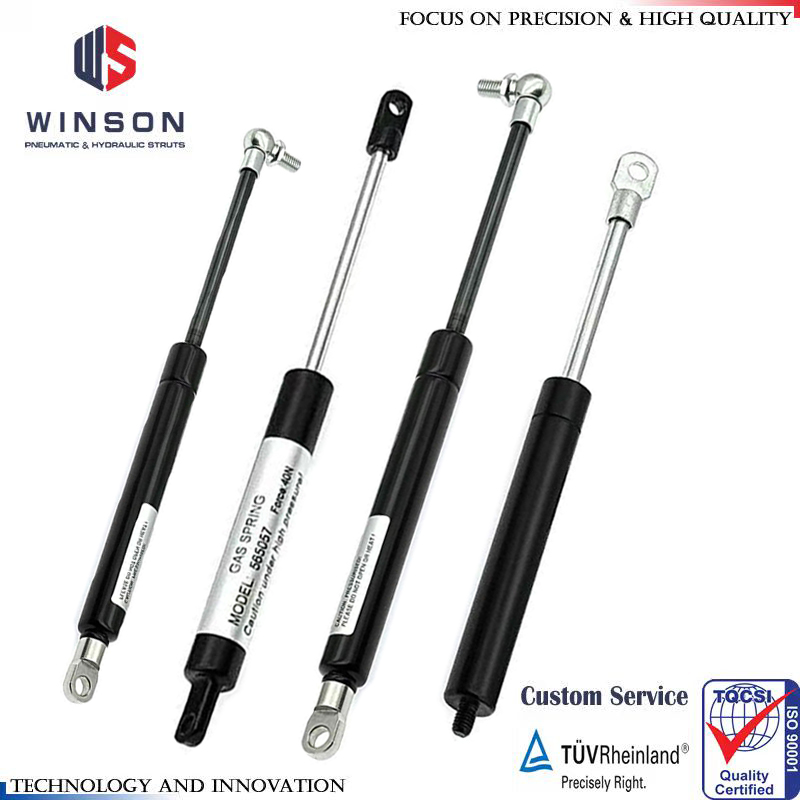
Part 1: Compression Gas Spring – The Simple 'Supporter'
Think of it as a constantly charged assistant. Its piston rod always wants to extend, providing continuous pushing force.
Key Characteristics
- Single-Action: Primarily provides force in the extending direction.
- Auto-Return:Extends automatically after being compressed and released.
- Cost-Effective: Simple construction, lower cost.
- Ideal Applications:
Car trunks/engine hoods
Lift-up cabinet doors
Storage bed lids
Industrial machine guard doors
- Choose this when you need: A 'push-to-open and it stays open' function.
Part 2: Lockable Gas Spring – The Intelligent 'Positioner'
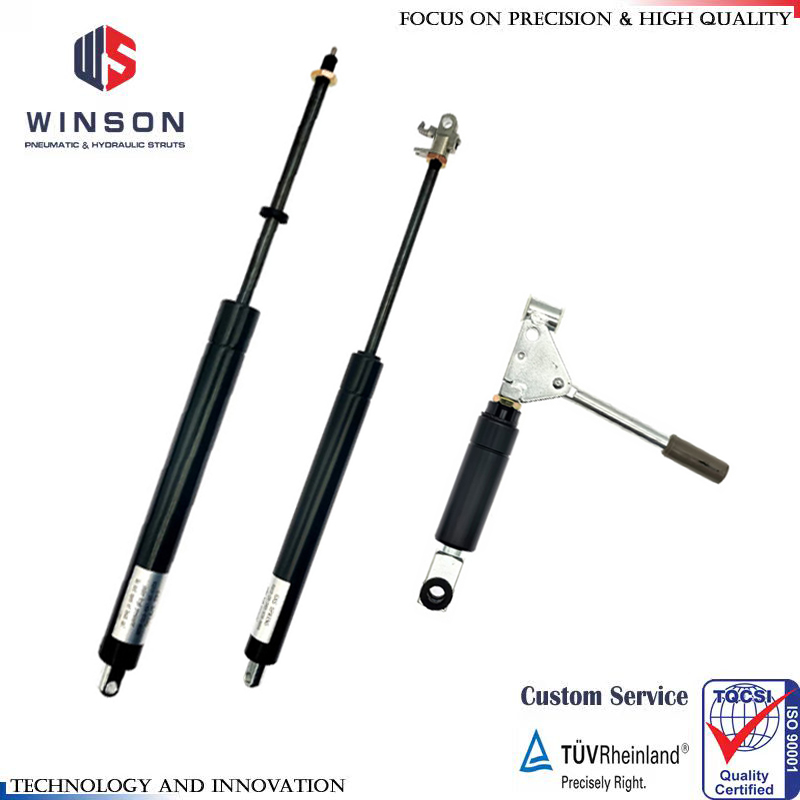
It adds a precise mechanical locking mechanism to the standard compression spring, allowing users to lock it at any position for accurate control.
Key Characteristics
- Dual Control: Free adjustment and locking.
- Precise Positioning: Fixation at any angle/height.
- Active Operation: Manual trigger required.
Types by Activation
- Cable-Actuated: Remote control via steel cable (preferred for medical beds).
- Button-Actuated: Press a button on the cylinder body (common for car seats).
- Lever-Actuated: Toggle via a lever (common in industrial equipment).
- Ideal Applications:
Medical/hospital beds
Office chair lumbar depth adjustment
Industrial safety doors (requiring locked open position)
Adjustable monitor arms - Choose this when you need: An 'adjust to a specific position and hold it securely' function.
 E-Mail & Wechat Whatsapp: +86 13819751436
Part 3: Decision Flowchart – 3 Steps to the Right Choice
Follow this logic to decide in under 30 seconds:
1. Does your application require 'fixing at a mid-position'?
└── Yes → Choose 'Lockable Gas Spring'
└── No →
2. Is it just 'push open and stay fully open'?
└── Yes → Choose 'Compression Gas Spring'
└── No →
3. Do you need 'slow closing'?
└── Yes → Choose 'Damped Compression Gas Spring'
└── No → You may not need a gas spring.
Part 4: Common Misconceptions Clarified
Myth 1: 'Lockable is more advanced, so it's always better.'
Fact: Over-engineering means wasted cost. Simple compression springs are optimal for suitable applications.
Myth 2: 'Once locked, it becomes completely rigid.'
Fact: All gas springs have minimal elastic deformation even when locked. They can still move under overload.
Myth 3: 'The types are freely interchangeable.'
Fact: Different installation and mechanical characteristics usually prevent direct swapping.
Part 5: Interactive Q&A
Q: Our office chair only needs height adjustment. Which type?
A: Choose a Compression Gas Spring. Office chair height is locked by an external clamping mechanism; the spring only provides support.
Q: Our medical bed backrest needs multi-angle adjustment. Which type?
A: Cable-Actuated Lockable Gas Spring is preferred. Nurses can operate from the bedside and lock at any angle, perfectly meeting care needs.
Q: Which type for a car engine hood?
A: Use a Compression Gas Spring. It provides stable support when fully open and requires only a light push to close
Conclusion
Choosing a gas spring isn't about 'good vs. bad' but finding the 'right fit.' Remember this core principle:
Compression Gas Springs solve 'automatic support' problems.
Lockable Gas Springs solve 'precision positioning' problems.
Once you clarify your product's actual usage scenario and functional needs, the right choice becomes clear. If you still have questions, feel free to share your application details for customized selection advice.
Ready to choose? Contact us we'll help you select the perfect gas spring solution!
Top

Winson is a Chinese Gas Spring & Hydraulic Damper manufacturer specializing in custom compression, lockable, tension types and stainless steel gas springs & oil dampers for a variety of applications of automotive and vehicle, furniture, machineries, medical & fitness equipments.
Contact Us
Tel/WhatsApp:+86 0137-80014913
Email: [email protected]
Address:(14-16),No.26,Building 4,Oriental Business Center, Yinzhou, Ningbo, Zhejiang, China 315100
Copy Right @ Winson Pneumatic & Hydraulic Struts All Rights Reserved
Custom Gas Spring & Hydraulic Damper For Global Clients | Phone / WhatsApp:+86 13780014913 | Copy Right @ Winson Pneumatic & Hydraulic Struts, All Rights Reserved.
 QQ
QQ WhatsAPP
 E-mail