
Welcome to the Winson Pneumatic & Hydraulic Struts official website!
 Tel:+86 13780014913
  E-mail:[email protected]



How the Impact of Temperature Change on Gas Spring Force? - Winson
Author:Winson Gas Spring & Hydraulic Damper
Click:
Time:2025-11-08 20:11:53
The Impact of Temperature Change on Gas Spring Force
Gas springs are vital components in countless applications, from automotive hatches to industrial machinery. However, their performance is not constant under all conditions. One of the most critical factors influencing their force output is **temperature**. Understanding this relationship is essential for designing safe, reliable, and long-lasting systems.
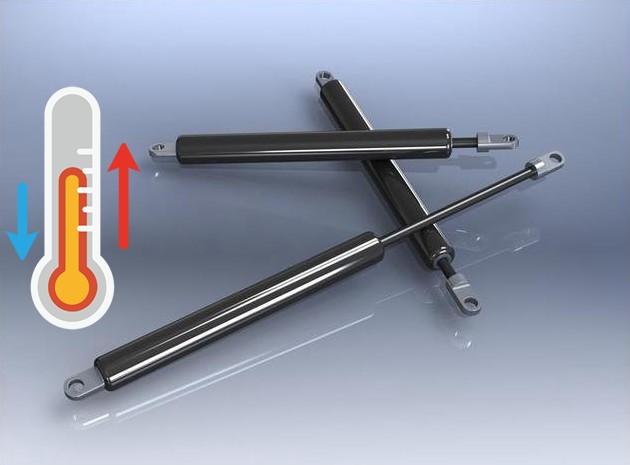
At Winson Gas Springs, we believe that a clear grasp of this fundamental principle is key to selecting the right component. This article explores how fluctuations in temperature directly affect the force a gas spring can exert.
The Fundamental Rule: Temperature and Force are Linked
The core principle governing gas spring behavior is straightforward:
**For every 10°C (18°F) change in temperature, the force output of a gas spring will change by approximately 3% to 4%.**
This change is bidirectional:
* **Force decreases by 3-4%** for every **10°C drop** in temperature.
* **Force increases by 3-4%** for every **10°C rise** in temperature.
The Science Behind the Change
This force variation is a direct consequence of the laws of physics, specifically the **Ideal Gas Law (PV = nRT)**. The pressure (*P*) inside the gas spring's cylinder is directly proportional to the absolute temperature (*T*) of the sealed nitrogen gas.
* Rising Temperature: As the ambient temperature increases, the gas molecules gain energy, move faster, and exert more pressure on the cylinder walls. This results in a **higher force output**.
* Falling Temperature: As the temperature drops, the gas molecules lose energy and their movement slows down. This leads to a **decrease in internal pressure** and a corresponding **reduction in force**.
Real-World Implications of Force Variation
A 3-4% change per 10°C may seem small, but its cumulative effect over a wide temperature range is significant and can lead to performance issues.
Consider this example:
A gas spring is specified to provide **500 Newtons (N)** of force at a standard **+20°C**.
* On a hot day at **+40°C**, the force could rise to ~530 N (a 6% increase).
* On a cold day at **0°C**, the force could drop to ~470 N (a 6% decrease).
This 60 N difference between extreme conditions can have serious consequences:
* **In a cold environment:** A hatchback may feel heavy, sag, or fail to stay open.
* **In a hot environment:** A lid may open too forcefully, posing a safety risk, and the increased internal pressure can place extra stress on the seals, potentially shortening the gas spring's lifespan.
Designing for Success: Accounting for Temperature
To ensure optimal performance, it is crucial to consider the entire expected temperature range during the design phase.
Key steps include:
1. Identify the Operating Range: Determine the minimum and maximum temperatures the application will encounter.
2. Model the Force Change: Calculate the expected force at the temperature extremes using the 3-4% rule.
3. Select the Correct Specification: Choose a gas spring with a nominal force that ensures sufficient performance at both the coldest and hottest conditions, without exceeding safety limits.
Conclusion
Temperature change is not a minor variable but a primary driver of gas spring performance. The force output is intrinsically linked to the thermal environment. By acknowledging this relationship and designing with the **'3-4% per 10°C'** rule in mind, engineers and designers can create products that are robust, safe, and functional year-round.
Have a project with challenging environmental conditions with gas struts?
[Contact our technical team today] for a free consultation and let us help you select the right gas spring for your needs.
Prev : Lockable Gas Springs: The Ultimate Solution for Precision Control and SafetyNext : Compression Gas Spring vs. Lockable Gas Spring: Core Differences and Selection Guide
Share this blog
YouArticle
已有0人推荐
Top

Winson is a Chinese Gas Spring & Hydraulic Damper manufacturer specializing in custom compression, lockable, tension types and stainless steel gas springs & oil dampers for a variety of applications of automotive and vehicle, furniture, machineries, medical & fitness equipments.
Contact Us
Tel/WhatsApp:+86 0137-80014913
Email: [email protected]
Address:(14-16),No.26,Building 4,Oriental Business Center, Yinzhou, Ningbo, Zhejiang, China 315100
Copy Right @ Winson Pneumatic & Hydraulic Struts All Rights Reserved
Custom Gas Spring & Hydraulic Damper For Global Clients | Phone / WhatsApp:+86 13780014913 | Copy Right @ Winson Pneumatic & Hydraulic Struts, All Rights Reserved.
 QQ
QQ WhatsAPP
 E-mail